 Preview Post
- October 5, 2026


Everyone in the industry can feel the shift. AI mode, AI Overviews, the new chat interface and the growing sense that classic blue link behaviour is slipping away. People are nervous about traffic, nervous about job security and trying to work out what on earth they are meant to optimise for.
The irony is that Google needs to solve the same problem: attribution. They cannot avoid releasing some form of visibility reporting forever. At some point the pressure from publishers, advertisers and regulators becomes too much. But that does not mean we will get prompt logs, clean queries or anything that resembles the comfort of old Search Console. The journey is going to be slow and messy because the underlying system is nothing like the one we are used to.
This is how I see it playing out.
Prompt tracking is not a slightly fancier version of keyword reporting. A single AI response can involve multiple internal queries, intent expansions, entity checks and re ranking steps before the model even considers writing a sentence. Turning that into a clean metric is not as simple as exposing a log file. Google has a few problems it must untangle first.
What actually counts as a prompt
A user asks one question, but the system sprouts several interpretation paths. Google has no internal definition yet for which one represents the true intent. They cannot expose something publicly that is not even defined privately.
What counts as an attribution event
If your content influenced the answer but the user only clicks four follow up turns later, is that still your referral. In classic search this question never existed. AI mode forces Google to make a decision they have not had to make before.
Privacy spillover
People speak to AI in a completely different way. Long, emotional, personal phrasing. There is no world where Google exposes anything resembling raw prompts. Everything will need to be smoothed, clustered and abstracted.
Commercial risk
Raw prompts plus raw retrieval patterns gives the entire industry a playbook for gaming the system. Google will protect that at all costs.
These points alone push the timeline out by years, not months.
This is the realistic timeline based on how Google handles ecosystem pressure.
2025
2026
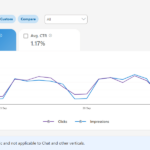
This is when we might see early signals. Think of something similar to Google Discover’s first appearance in Search Console. Useful to know AI exists, not useful enough to optimise.
Possibly:
• AI impressions
• AI assisted visits
• Basic visibility markers
2027
This is when the pressure becomes impossible to ignore. If AI mode becomes the primary entry point for users and traditional organic softens, Google will need to give more meaningful visibility.
Expect a dedicated reporting area with metrics such as:
• AI surfaced
• AI selected
• AI click throughs
• Topic or intent clusters instead of prompts
It will not be raw, but it will be enough to explain trends to a client or leadership team.
2028 and beyond
If regulator scrutiny increases or organic traffic reaches a political tipping point, Google will move into deeper attribution. Still aggregated, still privacy safe, but richer:
• Intent families
• High level semantic groupings
• Influence scores showing how strongly your content shaped an answer
This is as close as Google can get to proper attribution without leaking interaction data.
Example 1: The misleading traffic dip
A site sees a 10% drop in traditional blue-link clicks year on year. On the surface it looks like they are losing visibility. In reality, the same pages are being pulled into AI mode answers far more often, and users are clicking from the AI interface instead of classic search results.
The surface numbers fall, but the underlying influence rises. Without a clear AI filter, the trend looks negative when it is not.
Example 2: The false content diagnosis
An ecommerce site notices that several buying guides appear to be declining. The team assumes the content is outdated and begins planning a rewrite.
What they cannot see is that those guides are being cited frequently inside AI answers. Users are still discovering the content, but through a different interface. The rewrite would not fix the problem, because nothing is actually wrong. It is an attribution shift, not a quality issue.
Classic SEO lives in the deterministic quadrants of the Confidence in Search Systems Framework (CSSF). Query in. Result out. Clean cause and effect. It is measurable because it is structured.
AI mode throws everything into the probabilistic quadrants. Multi turn reasoning, fused sources, intent drift, conversational loops. The engine behaves less like an index and more like an interpreter. When a system becomes probabilistic, measurement becomes inherently blurrier.
Google’s real challenge is not technical. It is conceptual. They are trying to convert a probabilistic interaction model back into deterministic reporting. That takes time, both in product design and in political bravery.
This is the part people are quietly worried about, so it is worth addressing directly.
First, this shift is not the death of SEO. It is the reframing of SEO.
Visibility will still matter. Authority will still matter. Structured content, clean entities, relationships between topics, intent shaping, experience signals and expertise all become more valuable, not less. AI does not replace optimisation. It just changes the interface.
Second, your influence now sits earlier in the pipeline.
You are optimising to become part of the training, retrieval and reasoning stages. Not just the ranking stage. This is a bigger opportunity than people realise.
Third, your job becomes more about interpreting chaos calmly.
As the system becomes probabilistic, SEOs who can explain it without panic become very valuable. Leadership teams will rely on that clarity.
Fourth, you are not powerless.
There is still a direct line between producing genuinely useful content and being surfaced in AI answers. Google’s retrieval layer is not magic. It still prefers clarity, specificity, authority and structure.
So while attribution is lagging, influence is not.
Google will release AI attribution. They have no choice. But it will arrive slowly, wrapped in abstraction and shaped by political rather than technical timelines.
In a way, that is the story of this whole transition. Search is no longer a simple deterministic pipeline. It is a probabilistic reasoning system that happens to cite your content when you fit the intent. And measurement will always trail behind that shift.
The important part is this: we are still early. There is plenty of room for influence, for visibility and for new behaviours to emerge. The fear right now is understandable, but the opportunity is still wide open. You just need a different model of how the system works, and a calmer lens to look through.



Comments:
Comments are closed.